 The origin of the Past Pupils’ Movement is to be sought in the Preventive System, based as it is on the supernatural love of the Saint for the young. The pupils felt themselves loved by Don Bosco, not merely as pupils, but as sons, and consequently felt the need to return to their father’s house.
Even today the same spontaneous return is evidenced: a return to the school where the sensus revertendi is implanted and where all work with the spirit and method of Don Bosco. Thus it happened that the movement was not something thought up by the educators as a post-scholastic association, with predetermined ends and based on selected members, but was the work of forces which drew their origin and life from natural and vital causes.
The Past Pupils’ Association has now been in existence for more than 88 years. Its progress can be summarized in the following stages:
June 24, 1870
Beginnings: In the Mother House in Turin the past pupils, Reviglio and Gastini, the latter to become the first President, organized a demonstration expressing affection and gratitude towards Don Bosco on the occasion of his feast day.
Don Bosco encouraged this initiative and in the succeeding conventions in which he gladly participated, gave practical directives which later became the guiding lines of the Association.
1888
When Don Bosco died, the Past Pupils who had felt themselves the objects of his lively concern, decided that the best way to honor the memory of their great benefactor would be to give a stable form to their Movement. In this way the Federation of the Past Pupils of Don Bosco emerged, and in successive Congresses, national and international, in Spain, France, Belgium and Argentina, it gave signs of fruitfulness and vitality.
1911
 Saw the first International Congress in Turin with representatives from 22 nations. The Italian Press, which gave the event prominence, called it “a new departure in the history of pedagogy.” This Congress brought out a plan for an International Statute. From this too we have the project for the Monument to Don Bosco erected in front of the Basilica of Mary, Help of Christians, and the publication of the International Organ of the Association: Federazione
1914-1918
The International Movement in abeyance because of the First World War.
1920
In May, on the occasion of the inauguration of the Don Bosco Monument, the second International Congress was held in Turin. Here were laid down the cardinal principles, theoretical and practical, of a new Statute adapted to the changed conditions: a milestone in the third period of the history of the Movement. More important still was the foundation of a monthly: Voci Fraterne to take the place of the Federazione suspended during the war. Here, too, were approved the design of the badge, common to members the world over, and the personal membership card.
It was suggested to the Superiors that the ‘Hail Mary’ for the Past-pupils should be included in the Salesian prayers. The office of International President was established; this office was first held by Prof. Gribaudi, who was succeeded by Avv. Masera, from whom Arturo Poesio, took over in 1938.
1939-1945
The International Movement again suspended because of the War and political events.
1945-1953
Intense activity in gathering together the threads, and reweaving the unity between the Center and the outlying Federations.
1953
 A Meeting of capital importance for the National Federation of Italy. Under the presidency of A. Poesio and with the collaboration of the fifth Successor of Don Bosco, through intensive study and discussions, it became a constituent Congress of the Organization by means of the formulation not only of local Regulations but also of the scheme of a General Statute.
1954-1955
In November, 1954, the World Convention, called ‘Incontro Fraterno’ (Brotherly Reunion) was held in Turin. Thirty-five National Presidents with their Delegates took part. The meetings were held under the Presidency of Arturo Poesio and were attended by the Rector Major and the Major Superiors. The officers of the World Confederation were nominated, the basic Statute and the pertinent observations discussed, and then this Statute was provisionally approved for one year, the confederation being empowered to meet to give it definitive formulation.
This Confederation Committee, composed of the President, three Vice Presidents (the President of the National Federations of Spain, France and Argentina), the Secretary and a legal Consulter, met in Turin on the 12 and 13 of November, 1955, in the presence of the Rector Major. There, after receiving some slight modifications suggested by the Federations, the Basic Statute received its definitive formulation.
Organization
The Confederation the fruit of the Preventive System, inspired by the maternal goodness of Mary Help of Christians to Don Bosco, counting in its ranks men of all races and tongues, nations and customs, men from all walks of life and every level of civilization forges bonds of respect and affection between the educators and their one-time pupils which last as long as life itself. It cements among the Past Pupils a feeling of brotherhood and harmony of spirit, free from the urge of ambition, the desire to command, with no other stimulus than rivalry in doing good. In Italy, for example, there are over 800,000 Past-Pupils, 170,000 of whom are enrolled. In the world they number millions.
At present the Movement is organized as follows: a World Confederation which coordinates the activity of the National Federations; subordinate to these are the Regional Federations which in turn, control the local Centers. The governing bodies correspond to this organization. Every local Center is directed by a Committee.
The Presidents of the Centers constitute the Regional Council, which has as executive organ the Regional Committee. The assembly of the Regional Presidents form the National Council which has as executive organ the National Committee. The National Presidents in their turn, constitute the Council of the World Confederation, directed by the Confederation Committee, always the representative of the Superiors of the Salesian Society. The Unions and Federations have their own standard.
On the other hand, the insignia and symbol of the Confederation is the Banner which is carried by the Confederation Committee on the more solemn occasions and manifestations (as, for example, the International Eucharistic Congress at Barcelona, the National Eucharistic Congresses of Turin and Lecce), at the Congresses of the Past-Pupils, e. g. at the Inter-American Congress held at Buenos Aires in the presence of the Rector Major: August 1956. AIMS.
The following are the aims which the World Confederation, through the Federations and local Centers, has set itself in its effort to realize the ideal of Don Bosco ‘Da mihi animas, caetera tolle 1) to reinforce and bring to perfection in the souls of the Past-Pupils the spirit of Don Bosco, and to encourage the practical application of his teachings in individual, family and social life; 2) to promote the spiritual unity of the Past-Pupils and the actual membership of the Organization in its National, Regional and Local centers; 3) to preserve and reanimate the sentiments of affectionate gratitude on the part of the Past-Pupils towards their educators; 4) to keep in touch with the Past-Pupils and to keep alive among them the happy relationship of good fellowship, even to the extent of eventual reciprocal spiritual and material help; 5) to rouse and actuate those forms of personal and collective activity, which help to satisfy the religious, moral and cultural needs of the Past-Pupils.
The Confederation of Past-Pupils is free from politics and all class struggles. To attain its ends the Union engages in religious, cultural and social activities of various kinds, the details of which we have, unfortunately, not space to develop here.
Don Bosco’s advice: “Remain united and help one another” acts as an inspiration to all.
Source: From Don Bosco in the World

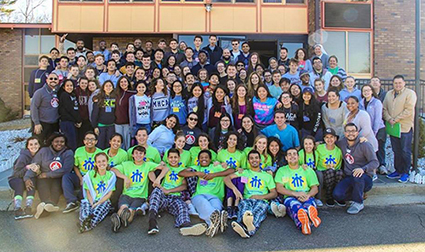 The Salesian Cooperators are Catholics who are living the Gospel message in the spirit of Saint John Bosco while choosing to live in the world.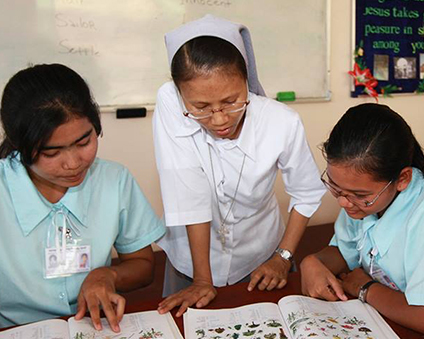
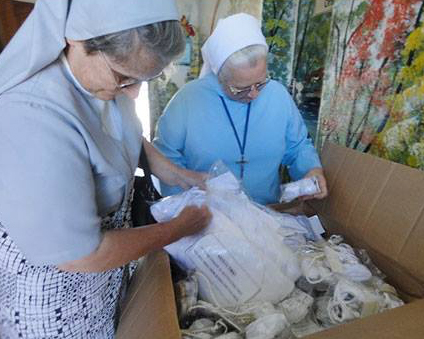
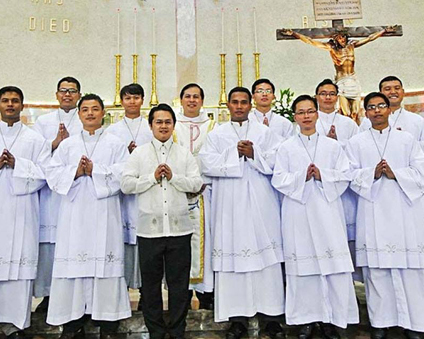
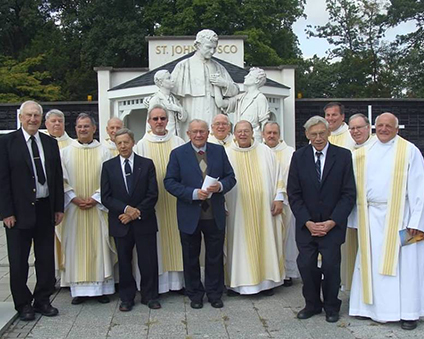 The first and solemn function of the profession of the group of the first seven numbers of the society of St. Francis of Sales and Mary Help of Christians.
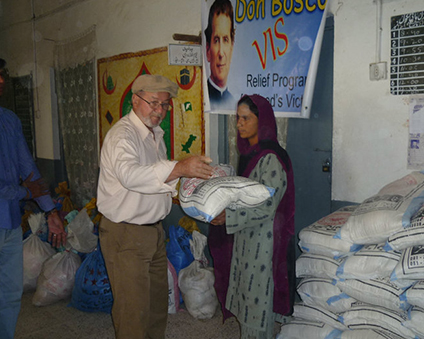
 There are 1,247 Don Bosco Volunteers, present in 36 countries: West Europe: 512, East Europe: 234, Africa: 9, North America: 9, South America: 386, Asia: 96, Oceania: 1.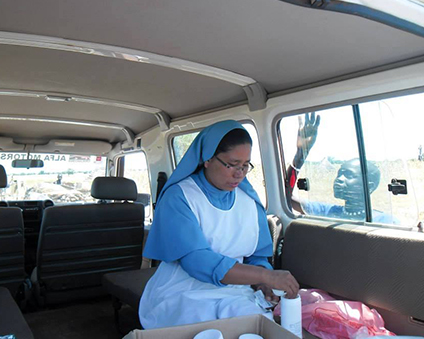
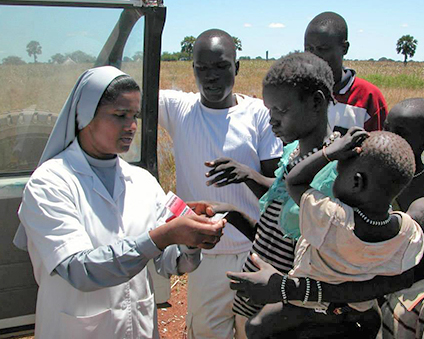 Founded at Buenos Aires (Argentina) by Fr. Aloysius Pedemonte, Salesian, on August 15, 1939. The members can be active with the vow of celibacy, or participating (married). The object of the Pious Union is the perfection of the members and the giving of good example in Christian life in the midst of their families. In particular, they are active auxiliaries in the parishes, teach catechism in schools, in outlying districts, and have work rooms for poor churches and for needy families. They also look after children of working class families. The Pious Union was recognized and commended by Pius XII.