
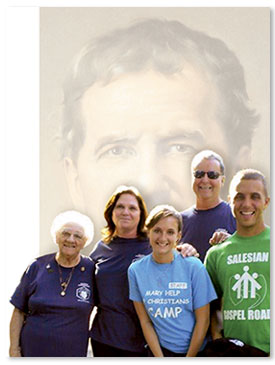
Don
Bosco had wanted to have "The Salesian in the world"
but had to be content with "the Salesian Cooperator."
Perhaps this is the best summary of the failure Don Bosco suffered
in a project that had been very dear to him. He had wanted to
create a branch of Salesians with full rights in the Congregation
though not bound by vows and not living the common life; he
succeeded only in getting half of what he had wanted. Even his
Italian facility for maneuvering and his Piedmontese tenacity
had to yield to the firm decision of those who considered his
plan unacceptable, and perhaps, at that time, it was indeed
not feasible.
The Union of Salesian Cooperators was officially established
in 1876, soon after the definitive approval of the Salesian
Society and at a time, when the Institute of the Daughters of
Mary Help of Christians was already making progress. It was
the culmination of a long struggle going back to the beginning
of the oratory.
First Non-Religious Helpers
Between 1841 and 1859, before the Congregation
took shape, Don Bosco needed help with looking after hundreds
of boys - a task he could not have managed alone. He always
found kind assistants who were willing to give up part of their
time to help Don Bosco with his homeless young.
The first helpers were priests and their task consisted mainly
of preaching, hearing confessions, and teaching catechism. Some
were very keen indeed on this kind of apostolate, as Joseph
Cafasso, Peter Merla, Francis Marengo, Louis Nasi, Lawrence
Gastaldi (future archbishop of Turin), Ignatius and Joseph Vola,
Giacinto Carpano, Michael Chiatellino, John Baptist Borel. Father
Borel deserves special notice. He had been Don Bosco's friend
and counsellor for a long time, and was also one of his most
faithful co-workers. In 1846, when struck down by a serious
illness, Don Bosco entrusted the care of the oratory to him.
He was much esteemed by the saint, who declared that he obtained
from their conversations "lessons of priestly zeal, unfailing
good counsel, and inspiration to be of service." Father
Borel also had the knack of holding his young audience spellbound
with his typical Piedmontese vivacity.
Soon there were lay helpers as well as priests, and they came
from widely different social backgrounds. Some belonged to well-to-do
families, even to the aristocracy, like Count Cays of Giletta
(who became a Salesian and a priest when well on in years),
Marquis Fassati, Count Callori of Vignale, and Count Scarampi
of Pruney. Among his helpers of more humble origin, Don Bosco
loved to recall the junk dealer, Joseph Gagliardi, who gave
his free time and savings to the boys of the oratory. Don Bosco
had long lists of helpers, some of whom were well known while
others were not. He faithfully remembered them all.
These laymen devoted themselves to whatever occupations they
were capable of, but it must be stressed that Don Bosco gratefully
availed himself of their services as "teachers of catechism"
on Sundays, and on weekdays during Lent. Some also helped with
the evening classes. In addition, they helped the director "with
the boys during church services and recreation; they organized
games and excursions; they attended to material needs and sometimes
paid for refreshments. Some took it upon themselves to make
sure the boys found suitable jobs and visited them at work to
keep in touch with the oratory.
The helpers however were not only men. Next to Don Bosco's own
mother, Mama Margaret, other women busied themselves with the
laundry and the boys' clothes; some of these were influential
members of high society. Don Bosco found this very helpful,
especially "since among those poor boys there were always
some who did not have a change of shirt or else whose clothes
were in such bad shape that no employer would accept them."
Among the "cooperators" who helped with these humble
and at times unsavory tasks we must first mention the Marchioness
Fassati, mother of the future Archbishop Gastaldi, for she had
undertaken the job of washing and distributing the clothes every
Saturday; on Sundays she would inspect the beds of the boarders
and then, "like an army sergeant" she would assemble
her troops and carefully check them for cleanliness.
Many of these kind helpers, ecclesiastic as well as lay, would
dip into their own pockets to help. One priest, for example,
gave all the money he received from his well-to-do parents to
Don Bosco for his boys; a banker gave a regular donation; a
certain artisan's savings were put at the service of those who
were poorer than he. Father Borel, who acted as treasurer of
the oratory, greatly appreciated this generosity.
Plans for Association
Don
Bosco soon realized that uniting these assistants into a group
would substantially increase their influence and effectiveness.
Was this perhaps the germ of the idea of a "Congregation"
for the education and defense of the faith among the people?
Although that was the idea, many helpers failed to fulfill his
expectations.
Some acted too independently; conflicts and political questions
caused many defections; one must also note that the disturbances
of 1848 had dramatic consequences for the director of the oratory,
at least temporarily. He then turned more and more to his boys
for the survival of his work. They were naturally more obedient.
After all, his dreams had foretold precisely that the shepherds
were to come from the flock! Hence in the summer of 1849, he
invited four of the boys to become his "helpers in running
the oratory," hoping to have at his disposal people of
the quality of Fathers Rua, Cagliero, and Francesia.
This did not stop him from accepting the kindness and help of
others. Despite difficulties and problems he always found someone
who asked only to be allowed to dedicate his or her services
to the boys in one of the three oratories in Turin. It is curious
to note that he began to use the term "Congregation of
St. Francis de Sales" around 1850 when referring to his
assistants. At this time he made a direct appeal to Pius IX:
"The priest of Turin, John Bosco, humbly informs your Holiness
of the lawful establishment of a Congregation of which he is
the director and whose purpose it is to instruct the homeless
young in religion and piety." Father Lemoyne explains that
this "congregation" was composed of priests and lay
folk.
In the same year Don Bosco tried another little known experiment,
mentioned by the author of the
Biographical Memoirs. In the evening of November 17, he called
a meeting of seven trusted men, "good lay Catholics,"
told them about "the abuses of the press in religious matters,"
the "sacrilegious war declared by many bad Christians against
the Church and its ministers," and the "danger of
seeing the true religion replaced by Protestantism in Piedmont,"
and proposed to set up a Provisional Pious Union under the protection
of Saint Francis de Sales. This provisional Union would be "the
beginning of a great association" of laymen which would
not exclude ecclesiastics; it would promote "all those
works of charity" aimed at preventing and if possible uprooting
the progress of impiety."
This project was not successful because, according to Father
Ceria, "laity set up like an army next to the clergy bred
resentment and concern at that time." It is proof, however,
that Don Bosco was then trying to organize, in his own way,
the outline of what would eventually become the Union of Cooperators.
Integration Foreseen
But Refused
As the years passed Don Bosco continued his
apostolate, helped by devoted clergy and lay assistants, and
the idea of an association was forming in his mind.
In 1859 he had succeeded in establishing the foundation of a
religious Congregation whose members-religious and lay-would
lead a common life bound by vows. But what about those other
helpers? He felt he could reward them for their work by allowing
them to be part of the Congregation regardless of secularity.
To this end he drafted a constitution which he sent to Rome
in 1864. It contained articles that dealt with the secular members
as follows: "1. Even though living outside, in their own
homes, with their families, they may belong to our Society."
"2. They will not be bound by vows, but they will try to
put into practice that part of the regulations that is compatible
with their age, profession, and position, such as teaching school
or catechism, encouraging the study of good books, using their
influence to promote triduums, novenas, spiritual retreats,
or perform other works of charity meant for the spiritual nourishment
of the underprivileged young."
Article 5 is noteworthy for a provision to the effect that "any
member of the Society, who leaves for good reason will be considered
an extern member."
What did Rome think about that? In his report of April 6, 1864,
the Secretary of the Congregation of Bishops and Regulars wrote:
"I think it would be wise to cancel all the articles of
chapter 16, concerning the affiliation of externs with the Congregation
which is dangerous, especially in our time." The remarks
of the press secretary, Svegliati, confirmed this: "It
is inadmissible that externs be admitted to the religious Congregation
through affiliation (Approbandum non est ut extraneae pio Instituto
adscribantur per ita dictam affiliationem.)"
Don Bosco did not give up; he tried to save "his"
paragraph but finally had to agree to put it into an appendix.
He made some changes (including the deletion of article 5) and
sent the entire draft once more to the Roman authorities. He
was able to get definitive approval of the constitutions in
l874, but only by deleting the disputed paragraphs. One hundred
years ago the time was not yet ripe for the acceptance of what
seemed an imprudent mixing of the religious and the secular.
Today, on the other hand, the Church actually encourages "secular
institutes" along the very lines envisaged by Don Bosco
in his own day.
A Kind of Third Order
A man like Don Bosco could not be discouraged,
and even though his proposition had been deleted from the constitutions,
he was determined to realize it in some other way. He then considered
creating a separate association, connected in some way with
the Salesians, i.e., a kind of Salesian third order. Before
finding a definite formulation in 1876, he had tried several
different ones.
On his return from Rome, after the approval of the religious
constitutions in 1874, Don Bosco drafted the outlines of a Union
of St. Francis de Sales. We are told that the members of the
superior chapter and the various rectors questioned in this
regard were not very enthusiastic; they assumed it would be
just another one of the many devout fraternities or associations.
To put their mind at ease, Don Bosco showed them the program
he had drawn up under the title Associates of the Congregation
of St. Francis de Sales. The aim of this "Salesian Association"
would reassure them for it was "to unite good Catholics
in one single purpose, which was to work for their salvation
and that of others according to the rules of the Society of
St. Francis de Sales."
Some Salesians thought the scheme too complicated. Don Bosco
revised and simplified it under the more general title of Christian
Union. It proposed "a way of life for secular members which
would somehow resemble the life of a religious congregation."
It was to be a kind of third order as of old except for emphasis
on the active life devoted in particular to helping the homeless
young rather than the exercise of piety that used to be the
main distinction of Christian perfection.
This set of rules was changed again and entitled Association
of Good Works.
Only in 1876 did Don Bosco find a definitive formulation: Salesian
Cooperators, or a practical way of promoting morals in civilian
society. He had the new regulations printed without delay and
sought official recognition for them. On May 9, 1876, he obtained
a brief of Pius IX equivalent to the Church's approval of the
"Union of Salesian Cooperators." It is to be noted
that during the audience the pope suggested that women should
be included without creating another third order and that they
be linked with the Daughters of Mary Help of Christians, as
Don Bosco had once thought of doing. With the pontifical approval
of 1876, an old plan of Don Bosco had materialized but in a
form different from what he would have wished.
Regulations of 1876
Before looking at the progress which Don Bosco
was soon able to achieve with the new association, it would
be useful to look at the basis of the Regulations, which were
the foundation of its success.
There were eight short chapters with the following titles: 1)
Christian Union for good works, 2) The Salesian Congregation
as a bond for union. 3) Aim of the Salesian Cooperators. 4)
Mode of cooperation. 5) Constitution and government of the association.
6) Special obligations. 7) Advantages. 8) Religious practices.
The Association of Cooperators depended on the Salesian Society
for unity. Its aim, which Don Bosco expressed in terms of struggle,
was to fight evil by helping the Salesians with their projects.
He quoted the example of the early Christians who, by virtue
of fraternal unity, succeeded in overcoming "the innumerable
difficulties in their path"; they had to "remove"
the evils which threatened the young and endangered the future
of society itself. Particular notice was taken of the missions
with urgent needs. This apostolic and social orientation did
not detract from the fundamental aim of the Cooperators; "to
benefit from living a life that resembled as far as possible
the common life." At the end of the third chapter one finds
an echo of the first article of the Salesian constitutions regarding
"Christian perfection" and "the exercise of charity
towards our neighbor and especially towards the neglected young."
Living in the environment in which Providence had placed them
the Cooperators expected spiritual guidance from the Salesians.
While leading "a normal family life" they could also
live "as though they were in a congregation." The
general chapter of 1877 was to state that the Cooperators "spread
in the world the spirit of the Congregation of St. Francis de
Sales. In order to guide and enrich their spiritual life, Don
Bosco gave them some directives on the value of simplicity and
righteousness, on the obligations to their position in society,
on the benefits of annual and monthly retreats, on the "exercises
for a happy death" and on frequenting the sacraments.
The activities of the Cooperators were similar to those of the
Salesian religious: catechism, lessons, retreats, searching
for and encouraging priestly vocations, dissemination of "good
literature," activities, on behalf of the young, prayer,
and alms; the latter term was used by Don Bosco in a broad context.
The Cooperator's activity, then, is Salesian, and it is rightly
called cooperation because both religious and non-religious
work and reap their harvest in the "same field," with
the same methods, and under the same superior. There were some
who tried to reduce the cooperation to mere financial aid. Though
material help was needed Don Bosco rejected this narrow interpretation.
"One must understand the aim of the Pious Union,"
he declared at Toulon in 1882. "The Salesian Cooperators
should not only collect alms for our institutions, but should
above all work for the salvation of their brothers and the young
in particular, with all means at their disposal, spiritual and
otherwise."
Finally this union. is an organization whose superior is the
head of the Salesians. "As to religion" however, it
will be "absolutely" dependent on the hierarchy. We
must explain this last point for it had not appeared in the
first drafts of the association. On the local level the Salesian
rector was to be responsible for the Cooperators, and if there
were no local Salesian houses, a Cooperator would be put in
charge of a group. Their program called for two annual meetings.
A fine passage in the sixth chapter is perhaps reminiscent of
the original idea of a congregation comprising both religious
and secular members: "The members of the Salesian Congregation
consider all their Cooperators their true brothers in Christ
and will call on them whenever their help can be used for the
greater glory of God and the good of souls. The Cooperators
in turn can similarly call on the members of the Salesian Congregation."
Although not allowed to use the word confreres, the professed
religious and their secular Cooperators were nevertheless united
in brotherhood.
Success of the Enterprise
Immediately after the approbation, Don Bosco
started talking, travelling, and recruiting. He had given himself
about two years to establish the association and he acted accordingly.
His methods varied but the results were gratifying. When he
anticipated no objection he would often merely send the regulations
and certificate of membership to the future Cooperator; for
people of some importance he would include a personal letter.
He tried to get distinguished names to add luster to his roster,
which was headed by Pius IX, who was very enthusiastic about
his ideas and remarked that he wanted to be not merely a Cooperator
but the first of the Cooperators. Later Don Bosco simply made
the same suggestion to the austere Leo XIII, who replied that
he wanted to be not only a Cooperator but also an "operator."
In the course of his various journeys through Italy, France,
and Spain, Don Bosco notably increased the number of his associates.
In Rome he won many great families and numerous prelates to
his cause; Genoa and Liguria provided large contingents. In
France, Nice became an important center, particularly on account
of the cosmopolitan nature of the city; at Marseilles Don Bosco
found the Cooperators so fervent that he felt immediately at
home with them. Among the great number of Cooperators some personalities
stand out: in Spain there was Dorotea de Chopitea, that great
lady of Barcelona who may one day be canonized. She was the
true "mother of the Salesian work in her country."
In France Claire Louvet d'Aire-sur-la-Lys and Count Louis-Fleury
Colle of Toulon deserve to be mentioned. An intense correspondence
was carried on between Don Bosco and the French lady who combined
the devotion of a spiritual daughter with the generosity of
a benefactress. Count Colle's name often occurs in Don Bosco's
life story, for he and his wife were extremely generous, especially
after the death of their son, Louis. Other names that should
be mentioned are those of the historian Cesare Cantu, the German
Mehler, the Hungarian Lonkay, the Jewish Lattes of Nice (one
of the most enthusiastic Cooperators, according to Don Bosco),
and Count de Chambord.
Don Bosco wanted to give to these Cooperators from all walks
of life something that would serve to unite them and at the
same time constitute a bond between the center of the Congregation
and its outposts (without forgetting its purpose of promotion
and fund raising.) In August, 1877 the first number of Bibliofilo
Salesiano (changed to Salesian Bulletin the following year)
appeared as a monthly periodical sent free to all who gave him
their assistance, large or small. The circulation of this magazine
increased year by year, reaching 40,000 copies in 1887. A French
edition appeared in 1879, and one in Spanish followed in 1886.
The periodic conference was another means for promoting unity
of spirit and increasing the number of Cooperators. Don Bosco
himself held over eighty such meetings, twenty-eight of them
in France. He took advantage of these "family reunions"
to spread the news of Salesian activities and to urge his listeners
to "cooperate" in every way in the immense work of
charity and evangelization to which he had consecrated his life.
One gets the impression that with growing success Don Bosco's
ideas about the Cooperators expanded. Conceived essentially
at first, as a "support of the congregation," he had
begun to see the association more and more as an ecclesial organism
which demanded personal commitment from its members. "The
Cooperators," declared the general chapter of 1883, "who
truly understand their purpose, will not merely help us but
will also carry out the special projects of the Salesians."
In the following year, when discussing his ideas with Father
Lemoyne, Don Bosco explained that "their true and immediate
goal was to help the Church, the bishops and the priests, under
the guidance of the Salesians."
At the death of Don Bosco in 1888 one thing was evident: the
apostolic strength of the humble Salesian Congregation had increased
tenfold through the "fraternal" help of his Cooperators.
Many of them deserve indeed to be considered in every way, except
canonically, true Salesians in the world.
Source: Don Bosco and the Salesians, by Morand Wirth